Biomimicry, the art and science of emulating nature's time-tested patterns and strategies, stands as a testament to nature being the finest designer in existence. This field seeks inspiration from the natural world to solve complex human problems, blending efficiency, sustainability, and aesthetics seamlessly. Below, we explore three compelling examples that showcase the transformative power of biomimicry in modern design:

1. Kingfisher-Inspired Shinkansen Bullet Train
The Shinkansen bullet train, renowned for its remarkable speed of 240–320 km/hr (150–200 mph), encountered an unexpected issue during its operation. When exiting tunnels, the train produced a loud "tunnel boom" due to the buildup of atmospheric pressure. The solution was found in the beak of the kingfisher bird, known for its ability to dive into water with minimal splash. By redesigning the train’s nose to mimic the kingfisher's beak, engineers enabled it to travel 10% faster while using 15% less electricity, effectively solving the noise problem and increasing energy efficiency. Source
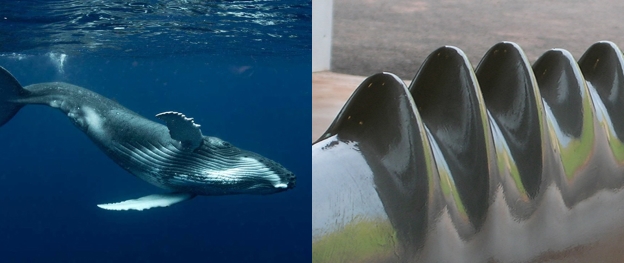
2. Whale-Inspired Wind Turbines
Humpback whales, despite their massive size, are remarkably agile underwater due to the unique structure of their fins. The fins have bumps called tubercles, which reduce drag and enhance lift. Engineers applied this principle to wind turbine blades, resulting in a 32% reduction in drag and an 8% increase in lift. This adaptation not only improves the performance of wind turbines but also demonstrates how biological insights can push renewable energy technology forward. Source

3. Airbus Inspired by Nature's Structure
Airbus engineers have also turned to nature for inspiration in redesigning airplane partitions. By studying the complex structure of a water lily's leaves, which combine strength with lightweight properties, Airbus developed a new partition for its aircraft that is both stronger and lighter than traditional designs. This bio-inspired structure contributes to weight reduction and fuel efficiency, showcasing how nature’s blueprints can lead to revolutionary changes in the aviation industry. Source
Humanscale and Biomimicry in Design Thinking
The Humanscale Design Studio incorporates ideas like biomimicry in its design thinking to create products that are functional, minimal, and sustainable. This design philosophy is evident in various products and approaches, showcasing that when humans look to nature, they tap into millions of years of evolutionary wisdom. Check out our recent exploration of biomimicry here.