This is a reprint of an article that appeared in MMQB on August 18, 2025.
Who's Really Leading the Sustainability Race in Contract Furniture? The Numbers Are In.
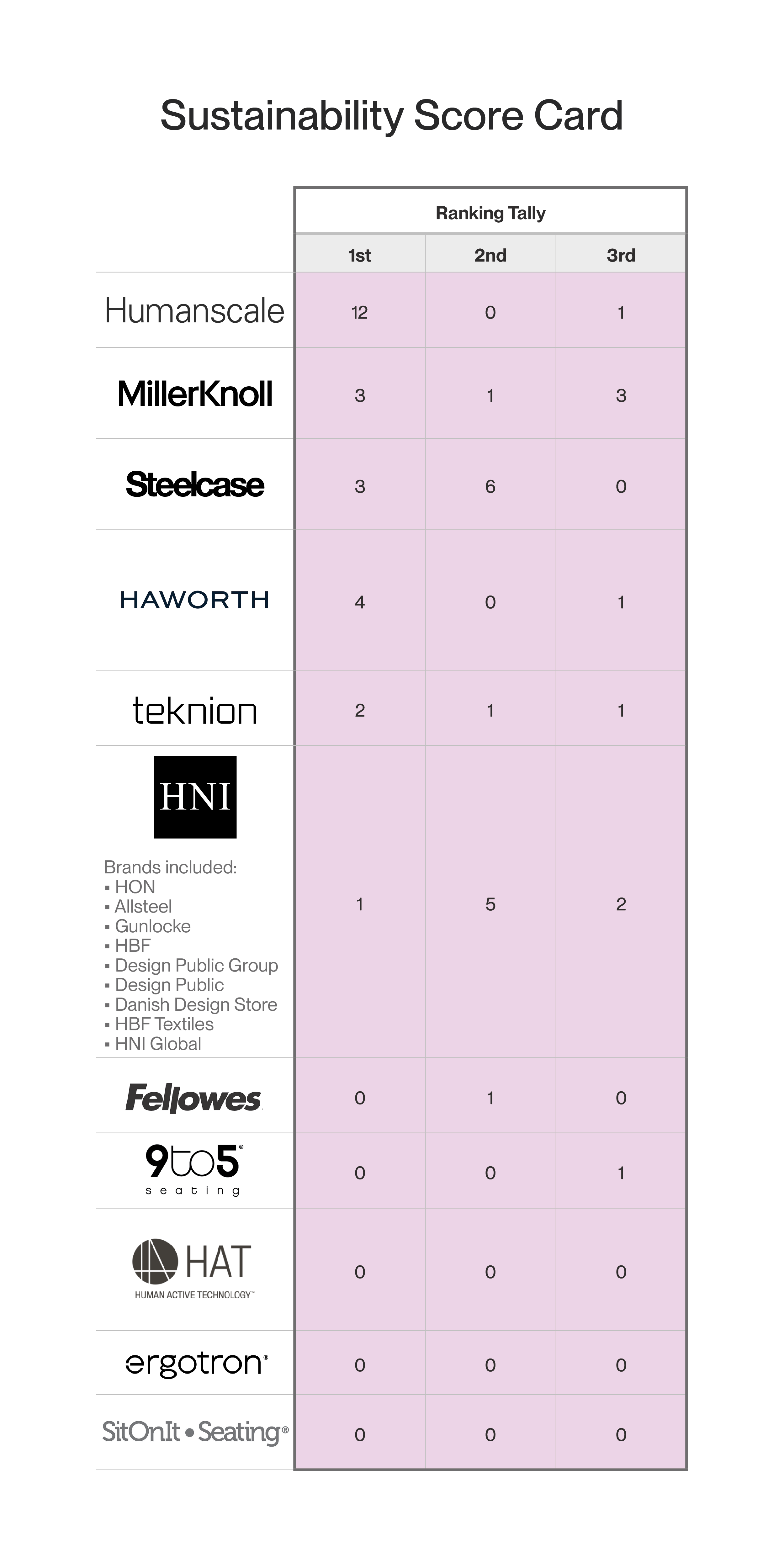
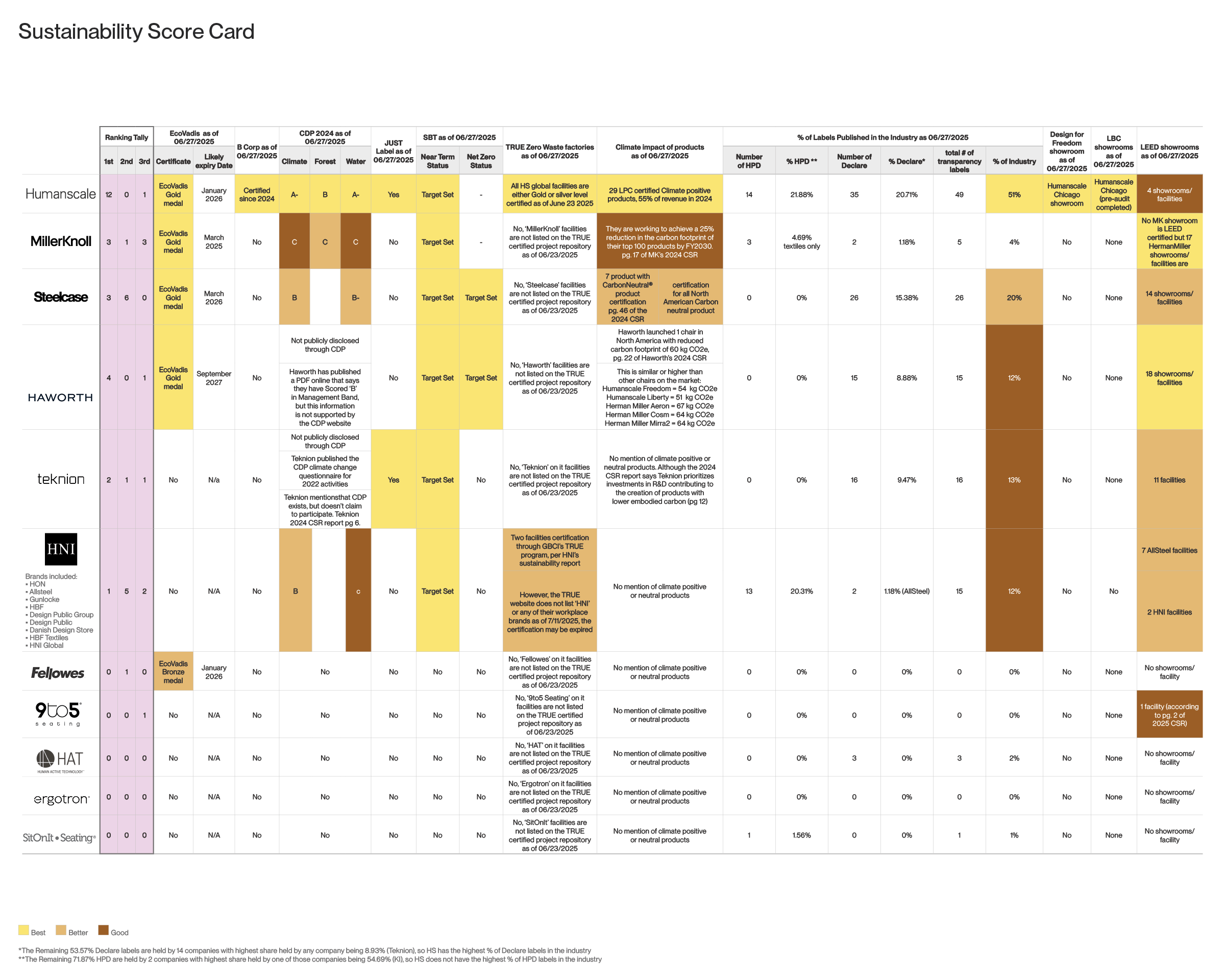
In an industry where nearly every company claims sustainability as a core value, MMQB is cutting through the greenwashing with something rare: verifiable data. We've reviewed third-party certifications, climate disclosures, and material transparency efforts across leading contract furniture brands—and the results may surprise you. But this isn't a one-and-done exercise. MMQB will be updating this sustainability scorecard on a regular basis to track who's making real progress, who's treading water, and who's hoping no one's paying attention. We'll hold the industry accountable—not just for what they say, but for what they actually do.
If you're tired of every furniture company declaring itself "the most sustainable" without receipts, we finally have the receipts. A new industry-wide sustainability scorecard, compiled from verified data across leading programs like EcoVadis, CDP, B Corp, JUST, and TRUE Zero Waste, lays bare who's walking the green walk—and who's just talking.
Let's not bury the lede: Humanscale is lapping the field.
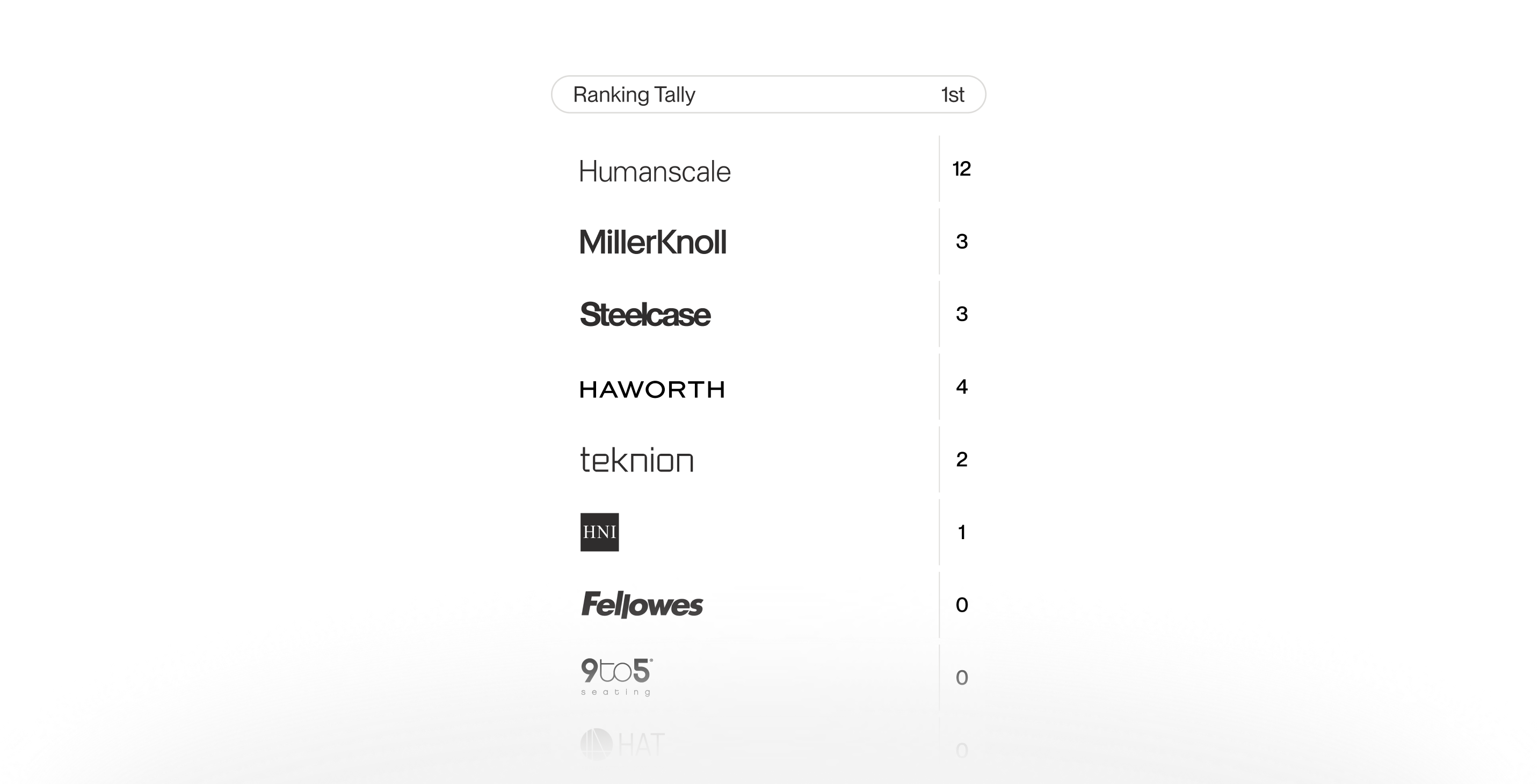
Humanscale ranks first overall in 12 out of 13 evaluated categories and places in the top three in seven. It has EcoVadis Gold certification (valid through January 2026), a B Corp certification, an A- rating in the 2024 CDP climate disclosure, and is the only company on the list to publish a full suite of climate-positive products—29 of them, in fact, accounting for 55% of its revenue in 2024. Its Chicago showroom has undergone a Design for Freedom pre-audit, and it has four facilities/showrooms with transparency credentials like LEED, LBC, or TRUE.
Perhaps most telling: Humanscale holds more Declare labels than any other company in the industry (20.71% of the total), and ranks second in the number of Health Product Declarations (HPDs). Transparency, meet impact.
Who's Playing Catch-Up: MillerKnoll and Steelcase
Two legacy giants—MillerKnoll and Steelcase—trail behind the leader in some key areas, though not without some merit.
MillerKnoll holds an EcoVadis Gold medal and is aiming for a 25% reduction in carbon footprint for its top 100 products by FY2030. But its TRUE Zero Waste status is absent, it lacks any climate-neutral or climate-positive product certification, and its presence in Declare and HPD labels is relatively weak (just 1.18% and 4.69%, respectively). It also doesn't have a single showroom with LEED certification under the MillerKnoll name, though Herman Miller legacy spaces still hold some ground.
Steelcase does slightly better with 26 Declare labels (15.38% of the industry total), and all its North American carbon-neutral products are CarbonNeutral® certified. It scores a B/B- on CDP disclosures and has set Science Based Targets—but lacks B Corp status, climate-positive product claims, and a TRUE Zero Waste listing. It's a solid "Better," but a long way from "Best."
Haworth, Teknion, HNI: Middle of the Pack or Missing in Action?
Haworth holds EcoVadis Gold and claims it scored a B from CDP, though that's not publicly verifiable. It does have a chair with a notably low carbon footprint (60 kg CO2e), but beyond that, the disclosures thin out. Its 18 facilities show no transparency certifications, and its presence in Declare and HPD labels is middling.
Teknion talks a good game about embodied carbon and innovation but has little to show in terms of third-party validation. It does not report to CDP (despite referencing it), holds no TRUE Zero Waste or LEED certifications, and has no carbon-neutral or positive products listed. The brand does, however, hold a 8.93% share of Declare labels, putting it in the "Good intentions, needs execution" category.
HNI and its various brands (Allsteel, HON, Gunlocke, HBF, etc.) do cite two TRUE Zero Waste certifications in their own reporting, but the official TRUE project repository does not list them, suggesting expired or unconfirmed status. Only Allsteel shows up in Declare labels—and only barely.
The Rear of the Pack: Fellowes, 9to5 Seating, HAT, Ergotron, SitOnIt
These names round out the list, and unfortunately, there's not much to say. Fellowes earns a Bronze EcoVadis rating, but no CDP data, no B Corp, no sustainability targets, and zero labels of any kind. The rest—9to5, HAT, Ergotron, SitOnIt—share similarly profiles: no verified sustainability reporting, no targets, and no published climate data. If you're looking for transparency, look elsewhere.
What Matters Most? Labels, Product Impact, and Reporting
While B Corp and EcoVadis medals give companies some street cred, the most meaningful differentiators are Declare and HPD labels—visible signals of material health and transparency—and published product-level climate impact data.
Only Humanscale hits all three. Everyone else is either picking and choosing or opting out entirely.
Conclusion: The Gap is Real
The contract furnishings industry likes to talk a big game about sustainability. But when actual data is compared side-by-side, the gap between leaders and laggards is wide—and growing. Humanscale stands alone at the top, backed by third-party audits, transparent reporting, and climate-positive products. Steelcase and MillerKnoll are trying but haven't caught up. And the rest? Many are still greenwashing without receipts.
In an era where RFPs increasingly demand real sustainability metrics, the choice between who leads and who lags is no longer just philosophical. It's practical—and, eventually, financial. So, let's get to work on fixing these shortcomings.
See and download the MMQB's full Sustainability Scorecard here.